
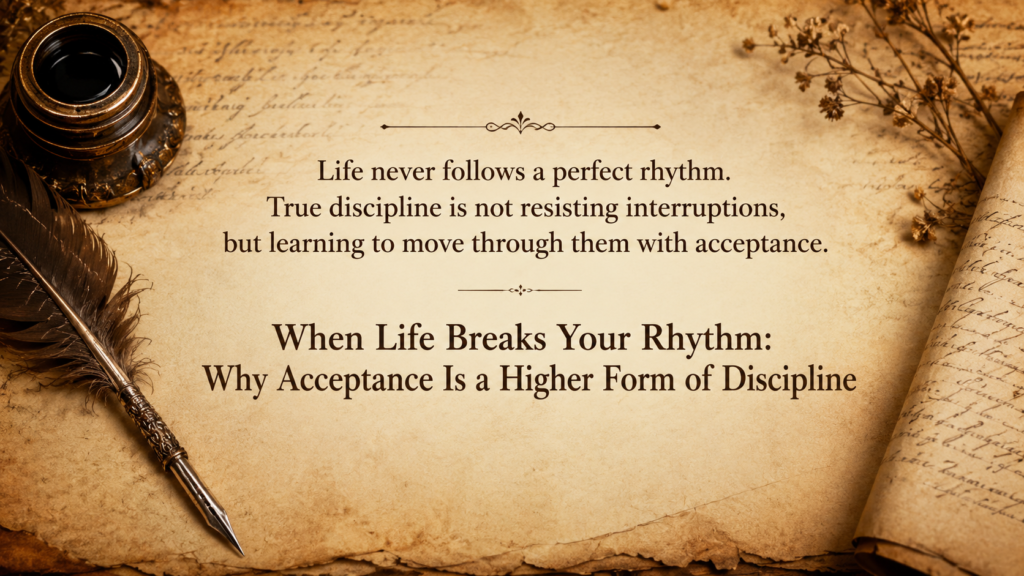
When Life Breaks Your Rhythm: Why Acceptance Is a Higher Form of Discipline
The Hidden Trap of Discipline
Every ambitious person dreams of building a disciplined life. We divide our biggest goals into small daily actions, create routines, and move consistently toward the future we imagine. Discipline gives us direction, consistency builds momentum, and daily effort slowly transforms our vision into reality. But there is one reality that almost every ambitious person eventually encounters—a reality that no amount of planning can completely avoid.
There are two extremes in human life. One person remains inactive, avoids responsibility, and spends life without engaging either the body or the mind. Such a mind gradually loses its natural sharpness. It becomes occupied by random thoughts, unnecessary comparisons, emotional disturbances, and mental stagnation.
The other extreme is the highly ambitious person. This article is about the second person.
The Hidden Trap of Discipline
An ambitious person usually has a vision for the future. That vision is slowly transformed into reality through disciplined daily actions. Large dreams are divided into small achievable tasks. Every meaningful achievement is gradually materialized through a sequence of consistent efforts. Physical discipline, mental discipline, recovery from fatigue, planning, execution, and consistency become part of everyday life. This is healthy. In fact, every meaningful achievement is nothing but the successful implementation of countless small activities performed consistently.
However, every ambitious person must understand one practical reality. Life never promises that your rhythm will continue uninterrupted. This is not a motivational statement; it is simply the nature of life. Human life is connected with countless possibilities. Unexpected events may arise at any moment. Someone close to us may suddenly become ill. A friend may meet with an accident. Relationships may demand our immediate attention. Financial situations may unexpectedly change. Some valuable belonging may be lost. Environmental conditions themselves may become unfavorable.
Even if every external condition cooperates with us, our own biological system may not. Inside the human body, millions of biological activities are taking place continuously. Occasionally, one or two of those processes become temporarily disturbed. That itself becomes illness, weakness, fatigue, or sickness. At that moment, even though your external world fully supports your ambitions, your own body does not.

When Life Naturally Breaks Your Rhythm
What can an ambitious person do then?
The answer is surprisingly simple. The activity cycle has to pause. Notice that I am not saying the journey has ended. I am saying that one activity has paused because another activity has become more important. This is not failure. It is a universal process.
Think about a piano. When one musical note is played, the previous note is released. Only then does harmony emerge. If every key remained pressed continuously, there would be no melody—only noise. Human life follows the same principle. Sometimes your professional work must pause because your biological system requires attention. Sometimes your ambitions must pause because your family requires you. Sometimes your routine must pause because life itself has presented another responsibility.
The mistake begins when the mind interprets this pause as failure. That interpretation creates disappointment. Disappointment gradually creates regression. Regression creates isolation. Isolation weakens the nervous system and slowly becomes the beginning of unnecessary psychological suffering. The real problem was never the interruption. The real problem was the interpretation.
Many ambitious people unknowingly become addicted to their own discipline. Discipline is healthy, but addiction to discipline is not. If your identity becomes completely dependent upon following a timetable every single day without interruption, then every unexpected situation begins to feel like an attack upon your life. That is not discipline anymore; it is psychological attachment disguised as discipline.
Human life is not governed by a single system. It is a living combination of biological, neurological, psychological, social, relational, environmental, and financial realities. All these systems together form one life. No single system can permanently dominate all the others. The moment we understand this, the mind naturally begins to distribute its attention and responsibility across every important dimension of life instead of becoming imprisoned by only one.

Acceptance Is a Higher Form of Discipline
Once we deeply understand this reality, something beautiful begins to happen. The mind gradually starts sharing its responsibility among all these dimensions of life. Earlier it believed, “My ambition is my life.” Now it begins to understand, “My ambition is one important part of my life.” This small shift changes everything.
Whenever an unexpected situation arises, the mind no longer says, “My work has been destroyed.” Instead, it quietly understands, “My attention has temporarily shifted from one part of my life to another.” That shift itself is acceptance. Acceptance does not mean giving up ambition. Acceptance means participating completely in the responsibility that life is presenting at this moment.
Today your responsibility may be your health. Tomorrow it may be your family. The next day it may again become your work. Every responsibility deserves complete participation while it is present. When one system becomes stable again, your attention naturally returns to another. Life gradually regains its rhythm. That is harmony.
The healthier way to think is not, “I must complete my timetable every single day at any cost.” The healthier way is, “Whenever I receive the opportunity to work, I will work with complete involvement. When life temporarily asks me to attend another responsibility, I will shift completely toward that responsibility. When the opportunity returns, I will once again return to my work with the same total involvement.”
Without regret.
Without mental residue.
Without continuously comparing today’s reality with yesterday’s plan.
This way of living protects both ambition and mental health. It protects discipline without allowing discipline to become psychological bondage. Goals are important. Effort is important. Consistency is important. But harmony is equally important. A disturbed mind cannot sustain disciplined work for very long. A harmonious mind can.
This article is not discussing spirituality. It is not discussing the ultimate nature of consciousness or the deeper questions beyond the human psyche. Its purpose is much simpler. Its purpose is to preserve psychological harmony while living an ambitious physical life.
Life will never remain perfectly predictable. Unexpected situations are not exceptions; they are part of being human. The healthier mind is not the one that never faces interruptions. The healthier mind is the one that knows how to shift gracefully from one responsibility to another without carrying regret, disappointment, or unnecessary mental residue.
That is not weakness.
That is a higher form of discipline.
Continue Your Journey of Thought
Every meaningful transformation begins with a shift in perception.
If this reflection resonated with you, continue exploring these related articles.
🪶 A Unique Idea Is Differentiated, Not AI Tools Mastering
🌿 Take Charge Today: Your First Step Towards a Life That Works
Explore Another Health Reflection
Digestive health begins with understanding the root causes, daily habits, and natural healing approaches. Continue reading this detailed health article for additional practical insights.
Opens in a new window