
Human consciousness today is largely spread outward. Attention is continuously pulled into activity, stimulation, information, and survival-based engagement. Especially in what is traditionally referred to as Kali Yuga, this outward dispersion has reached an extreme level. Kali Yuga need not be understood as a belief or sentiment. It can be seen as a phase in the larger evolutionary timeline of the universe, the environment, and human biology, where external stimulation dominates inner awareness.
Destruction in this context does not mean only physical damage. It refers to deviation — deviation of attention, deviation of awareness, deviation from one’s natural center. From the late twentieth century onward, media began binding human consciousness to screens. With digital platforms, infinite scrolling, and artificial intelligence, this deviation has intensified further. Life has become easier and more efficient, yet simultaneously more distracting.
Another major shift occurred through lifestyle changes. Earlier, human survival naturally involved physical effort. Work, earning, cooking, movement, and daily activities required bodily participation. This maintained active metabolism, grounded nervous systems, and natural mental presence. Inner awareness did not need special protection because it was sustained through effort-based living.
As mechanical systems, automation, and digital technologies advanced, physical involvement steadily reduced. Life became simplified faster than human consciousness could adapt. When effort disappears, energy has no natural outlet, and the mind seeks stimulation. This leads to excessive indulgence in media and passive consumption.
In such a condition, self-identification — knowing where one comes from and what one essentially is — becomes extremely difficult. Awareness itself has not disappeared. It remains abundant, omnipresent, and freely available. There is no payment, no subscription, no ownership. The only requirement is sustained attention. But in a chaotic environment, attention itself has become scarce.
This is not a judgment on technology. Technological evolution follows natural cycles of creation, saturation, and transformation. The concern here is the individual interior consequence — diluted concentration, weakened observation, and fragmented awareness.
Recognizing this tendency long ago, human cultures did not rely solely on instruction or philosophy. They designed environments. Certain spaces were intentionally placed at the center of villages and towns to act as external triggers — gentle interruptions that redirected attention inward.
The purpose of entering such places was never excitement or entertainment. It was to calm the senses and allow a first experience of inner stillness. Before inquiry could happen, chaos had to reduce.
The Role of Natural Ambience Around Sacred Spaces
Another important aspect that often goes unnoticed is the environment surrounding these sacred structures. Traditionally, temples and other sacred places were not isolated constructions. They were embedded within carefully maintained natural surroundings.
Gardens filled with flowers were commonly present. This was not merely symbolic of beauty. Flowers influence the sensory field subtly — through fragrance, color harmony, and organic irregularity. These natural patterns soften visual aggression and relax the nervous system. The mind responds differently to organic forms compared to sharp, artificial structures.
Beyond aesthetics, vegetation plays a direct role in environmental purification. Trees and plants regulate temperature, increase oxygen content, reduce dust, and stabilize microclimates. This creates a calmer atmospheric layer even before one enters the built structure.
Certain trees were almost always present within temple compounds. Neem, peepal, banyan, and similar species were intentionally planted. These are not ordinary trees. Neem, in particular, is known for its air-purifying and antimicrobial properties. Peepal trees influence oxygen cycles differently compared to most plants. Such trees subtly condition the surrounding air and space.
For a person approaching such a place, the transition begins outside the structure itself. The senses start slowing down. Breathing changes. Body temperature stabilizes. Attention becomes less scattered. By the time one reaches the architectural core, external noise has already reduced.
In earlier times, land availability allowed this natural buffer to exist fully. With urban expansion and land scarcity, many modern constructions have lost this outer layer. The structure remains, but the preparatory environment is missing. This weakens the overall effect, though the core intelligence of the space still functions at a subconscious level.
Architectural Design and Geometry
The geometry of a space directly influences mental harmony. Even today, entering a cinema hall creates excitement before the film begins. This is not because of content, but because of spatial scale, enclosure, and visual focus. The brain maps the geometry and prepares for stimulation. The same content shown in an open field does not create the same impact because the geometry does not support it.
Sacred architectural spaces work in the opposite direction. They are designed to reduce stimulation.
Transitional spaces allow the body and nervous system to slow down. The traditional use of stone provides natural cooling and grounding. Stone also reflects sound effectively, allowing subtle resonance to circulate within the space. This softens external noise and makes one aware of one’s own movement and presence.
As one moves inward, spaces become progressively restricted. Movement slows. Light reduces. Sound converges. The environment itself encourages centricity. The innermost space is intentionally limited in access so that attention does not become generalized. Restriction preserves stillness.
Upper structures are often conical or pyramidal — not for decoration, but for functional reasons. Such geometry limits excessive sound reflection and allows controlled convergence of sound and light toward the center. Humans are deeply influenced by sound waves, and controlled resonance quiets the nervous system.
Sound, Material, and Resonance
Even central forms within these spaces are traditionally made of stone, allowing sound to reflect and sustain. This enables a form of environmental self-tuning.
Chanting or rhythmic prayer further strengthens this effect. Rhythm organizes breath, synchronizes neural patterns, and creates vibrational continuity. When such sound circulates within a stone-built, geometrically convergent space, it forms a closed vibrational loop. The human psyche naturally becomes focused.
Across cultures, bells or resonant instruments are used at entry points. These sounds interrupt mental noise immediately. Made from highly resonant metals, they produce sustained vibrations that the nervous system easily entrains with. Thoughts pause. Attention shifts. Awareness aligns with sound.
After resonance settles, silence emerges. In that silence, inward awareness becomes possible — without instruction, without effort. The space does the work. The individual only has to be present.
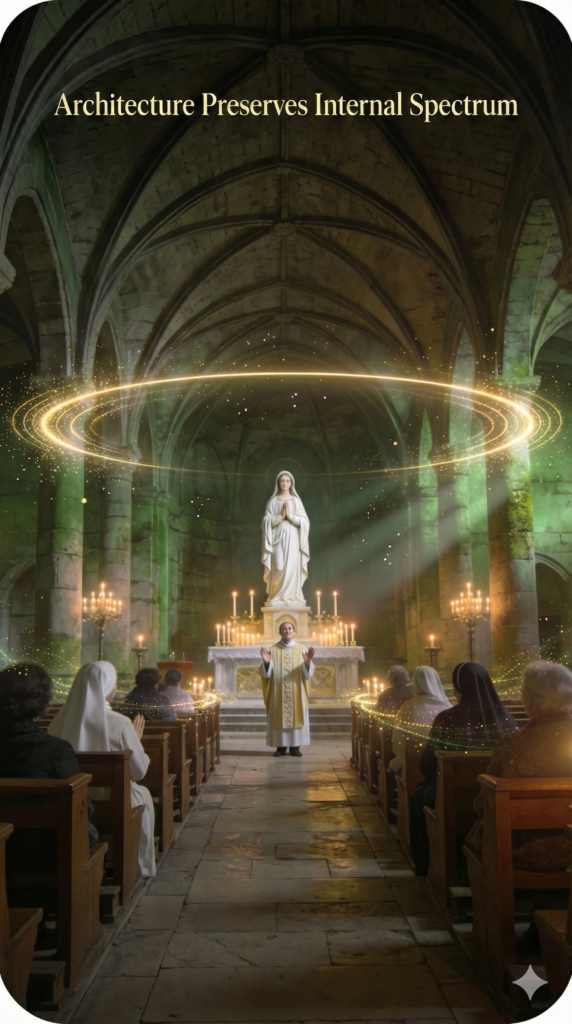
The core idea is simple. No interpretation is required. Only observation.
These architectural spaces were never about religion. They were about preserving the possibility of inner awareness in an outward-pulling world.
Continue Exploring Inner Awareness
If this exploration of sacred architecture and inward intelligence resonates with you, you may find deeper clarity in the following reflections:
Loneliness as an Opportunity to Open Another Dimension
Understanding how solitude can become a gateway rather than a burden.
Why Thoughts Disturb Meditation and How to Be Away from Them
A grounded explanation of thought interference and natural inner settling.
These writings are not meant to instruct, but to re-orient attention inward.
Read slowly. Observe quietly. Let understanding emerge naturally.
The content presented on this blog represents my personal opinions and experiences. It is based on my listening to the inward sound (Omkaranadam), my personal vision, and my forward intuition. While the ideas shared are deeply meaningful to me, they are not random statements, nor should they be interpreted as verdicts, prescriptions, or advice for anyone.
This content is meant purely for personal reflection, discussion, or exploration of philosophical and spiritual ideas. Readers may choose to engage with it as a discussion about consciousness, God, or spiritual exploration, or simply as a creative and thought-provoking experience.
I do not claim any authority, and no part of this content is intended to insult, offend, or challenge any religion, belief, or individual. It is a humble sharing of my journey and insights with the wider universe of readers and seekers.
For a deeper look at how environment shapes mental balance, read this external reflection:
When Climate Heals the Mind: Ayurveda’s Hidden Dialogue with the Environment →