
The Battlefield of Your Biology: Decoding the Bhagavad Gita as a Manual for Systemic Realignment
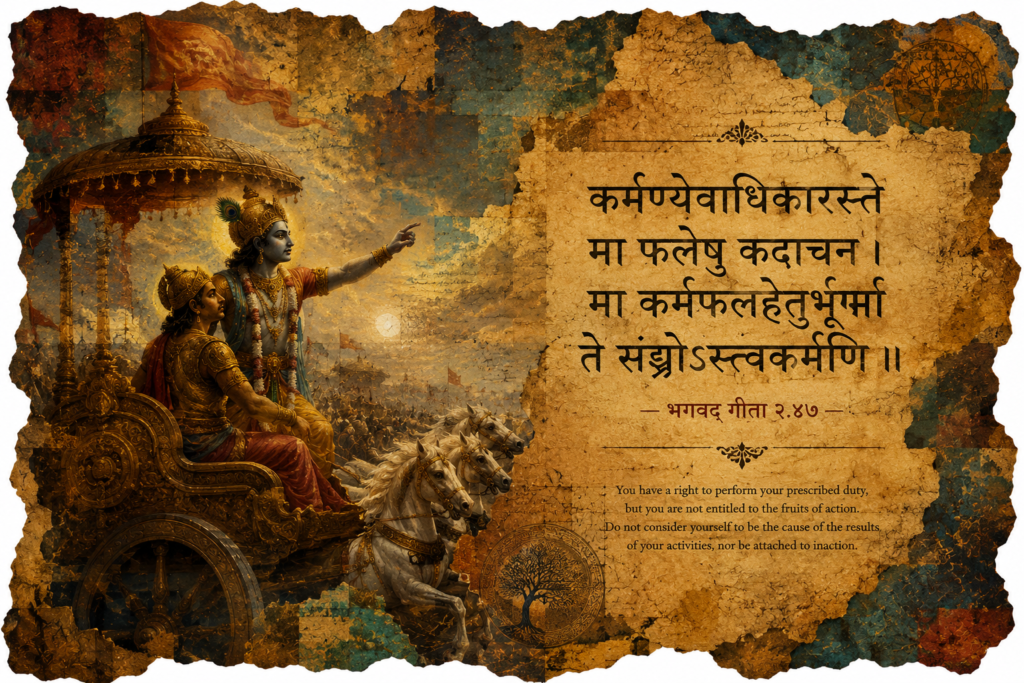
The Bhagavad Gita has served for millennia as a guide for humanity, offering clarity in moments of deep crisis. While traditional commentaries focus on its devotional or ethical dimensions, viewing this epic through a neuro-anatomical lens reveals an equally powerful layer: a technical manual for understanding the human nervous system.
When we view the battlefield of Kurukshetra not merely as a historical site, but as the high-entropy environment of our own internal conflicts, the Gita transforms into a guide for systemic realignment.
The Anatomy of a Breakdown: Arjuna and the “Grip”
In the traditional narrative, Arjuna stands on the battlefield, paralyzed by grief at the prospect of fighting his own kin. This is a moment nearly every human has experienced—that paralyzing gap between knowing what must be done and feeling physically unable to act. We experience it before difficult conversations, major life decisions, moments of loss, or when fear overpowers conviction. The battlefield may look different from Kurukshetra, but the inner hesitation is remarkably familiar.
Through a neuro-anatomical lens, we understand this struggle as a conflict of the Manas (mind) and Buddhi (intellect). When the psyche becomes misaligned, it experiences kārpaṇya-doṣa—a “miserable weakness” where the nervous system is seized by the “grip” of ego. This is a biological miscalculation: the nervous system attempts to “own” the muscle, creating physical stiffness, pain, and systemic exhaustion.
The Neuro-Anatomical Key
To bridge traditional wisdom with this anatomical perspective, we can map the characters to the human system:
- Krishna (Kootastha / Vitality): Symbolizes the Central Nervous System’s baseline—the stable, untouched flow of consciousness at the peak of the spine.
- Arjuna (The Perceiver/Psyche): Represents the mind when it is caught in the turbulence of the Gunas (the modes of nature), losing touch with its own clarity.
- Pandavas (Sensory Channels): The five senses. When directed by Dharma (natural order), they function as the channels that maintain a direct link to the Source.
- Kauravas (Neural Branches): The 100 neural branches extending into the biological body. They are neutral conduits representing the system’s machinery executing the commands of the psyche.
Why Your ‘Duryodhana’ is Just a Reflection
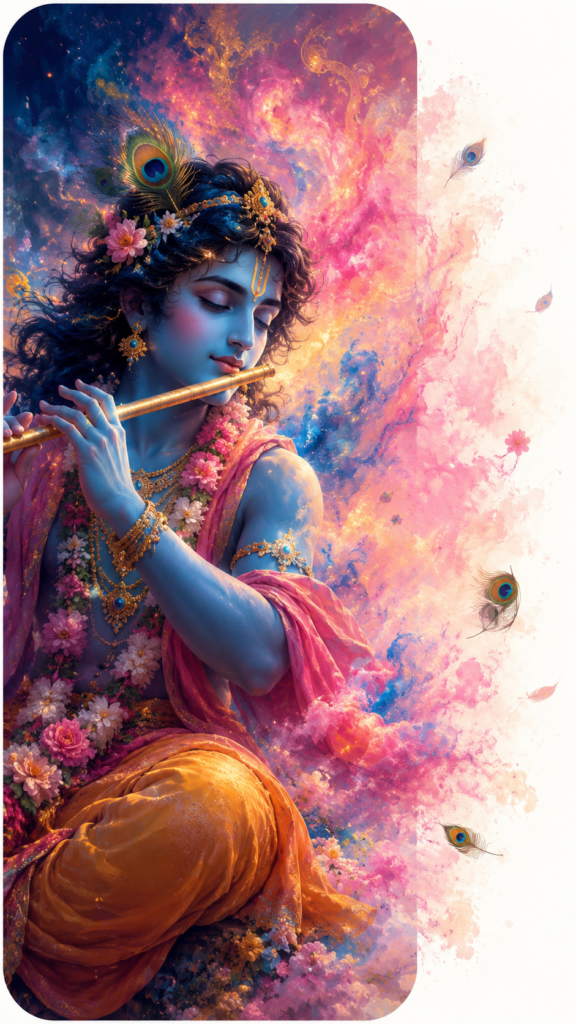
The war of the Mahabharata is not fought between two external armies; it is an internal process of feedback. Distorted neural currents, born of egoic attachment, are reflected and bounced back to the head cluster. This “bombardment” of self-attacking thoughts is Duryodhana.
Arjuna empowers Duryodhana. The Perceiver creates the monster it fears. As long as the psyche is identified with the limitations of the body, the “war” continues. When the Perceiver is aligned, there is no Duryodhana, no Kauravas, and no separate Arjuna—there is only the flow of Sarva Vyapaka (Omnipresence).
The System Reset: Surrender as a Mechanical Switch-off
Krishna’s instruction to Arjuna is a masterclass in Karma Yoga.
kārpaṇya-doṣopahata-svabhāvaḥ
pṛcchāmi tvāṁ dharma-sammūḍha-cetāḥ
yac-chreyaḥ syān niścitaṁ brūhi tan me
śiṣyas te ’haṁ śādhi māṁ tvāṁ prapannam
”My nature is overwhelmed by the weakness (kārpaṇya-doṣa) of pity. My mind is confused about what my duty is. I am your disciple, and I surrender to you; please instruct me on what is truly best for me.” (Bhagavad Gita 2.7)
True surrender in this context is the “switch-off” of the egoic loop. It is the cessation of the “grip.” When the psyche stops identifying with its own “mental movies,” the reflected currents cease to bombard the head. This leads the seeker toward the state of Sthitaprajña—a mind established in steady, unshakeable wisdom.
The Final Vision: Divya Rupa Sandarshana
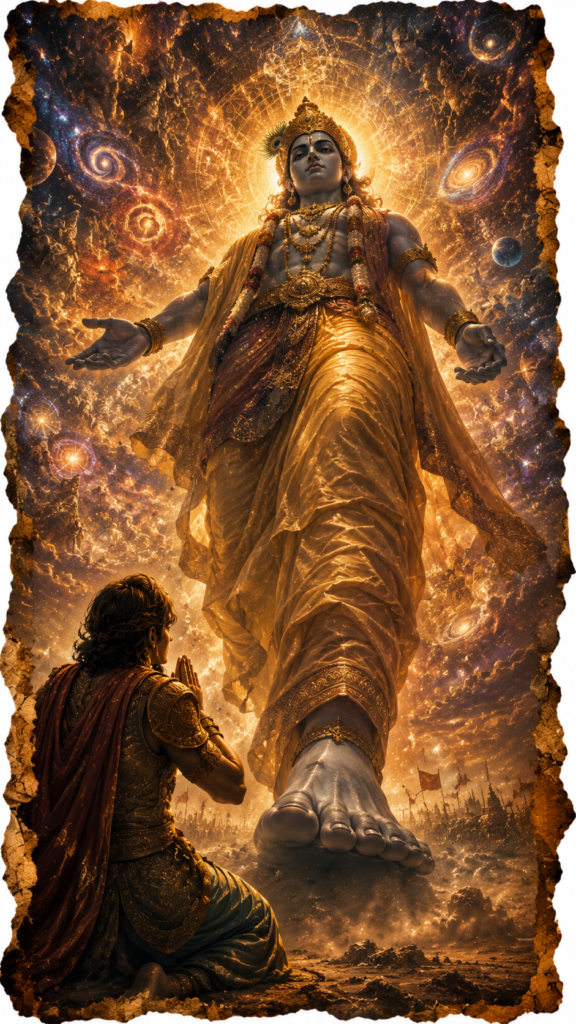
The Divya Rupa Sandarshana—Krishna’s Universal Form—is the raw reality revealed once the filter of the ego is stripped away. It is the recognition that you are not a local point in a biological machine, but the Space through which all biological events flow.
The war ends not because one side wins, but because the Perceiver has finally stopped creating the characters. The system returns to its inherent, natural flow. You aren’t “gaining” salvation; you are simply witnessing the removal of the “I” that prevented you from seeing that you are, and have always been, the Sarva Vyapaka—the Vitality itself.
Perhaps the battlefield of Kurukshetra is not only a place remembered in history, but also a condition that quietly unfolds whenever the mind loses alignment with its own deeper clarity. By understanding the anatomy of the struggle, we reclaim our ability to act—not from a place of fear, but from the steady flow of the Source itself.
Explore More on Spiritual Growth
Continue exploring the deeper challenges and transformations that come with a spiritual journey.
Read: The Uncertainty That a Spiritual Life Demands One to FaceUnderstand the Psychology of Progress
Discover why long journeys feel difficult and what hidden forces shape our progress.
Read: Why Long Journeys Feel Hard: The Hidden Psychology of ProgressRead the Complete Reflection
Explore this deeper reflection on the unspoken struggles that shape human experience.
Read Full Article