
Why Thoughts Disturb Meditation and How to Be Away From Them

Often we feel that we are disturbed by thoughts during meditation. People commonly complain that thoughts keep coming and prevent them from experiencing stillness. So what should we do? Is controlling thoughts possible, or is there another way? Let us explore this.
Omkarnatham (Sound of the Soul)
When you gently close your eyes and take two or three conscious breaths, your scattered awareness shifts inward. In this inward shift, the first thing you often sense is the subtle Omkarnatham — the natural inner sound produced by your nervous system.
It is not supernatural; it is simply the vibration of your Ida–Pingala networks moving like currents.
As awareness becomes subtle, this inner sound becomes clearer. But many people wonder: “Even while resonating with Omkarnatham, why do thoughts still come?”
To answer this, we first need to understand how the psyche forms and how thoughts are manufactured.
Manufacture of Thoughts
Thoughts do not arise at the surface of the mind. They have a very deep origin. We can understand this in two stages:
Stage 1 — Formation of the Psyche
(Place: subtle center of consciousness — Kutastha / Brumadhya)
This stage is purely inner-energetic and happens at the Kutastha (Brumadhya), the subtle centre behind the eyes, sometimes described in Western thought as the “seat of consciousness.”
- Deep Breath Pathway
A deep inhaled breath (which happens naturally and travels from the back of the nose to Kutastha / Brumadhya — a subtle, generally unidentified path by ordinary people or those absorbed in worldly life) rises and reaches the inner centre. - Nervous Currents (Ida–Pingala)
The Ida and Pingala currents rise and meet at the same point — Kutastha / Brumadhya. - Inner Intellect (Antah-Chaitanya)
The inner-intellect/light of awareness also touches this point and joins the other two. - The Combination Creates the Psyche
These three influences:
Subtle deep breath
Ida–Pingala nervous currents
Inner-intellect
combine at a single point. This combination produces a chemical / meta-chemical flash, which is the formation of the Psyche itself.
➡️ Stage 1 Output: Psyche is formed at Kutastha / Brumadhya.
Stage 2 — Formation of Thought (Mental Movie)

Once the Psyche is formed, it immediately begins capturing inputs.
- External Inputs Entering the Psyche
Visuals through the eyes
Sounds through the ears
Smells through the nose
Touch, pressure, temperature sensations through the skin
- Internal Inputs Entering the Psyche
Nervous intentions (subtle, micro-intentions from the nervous system)
These often blend especially with skin-related and smell-related inputs.
- The Blending Inside the Psyche
Inside the Psyche, all these streams merge:
audio
visual
smell-based signals
skin sensations
internal nervous intentions
subtle emotional residues
- The Psyche Creates a Mental Movie
This blending produces a mental movie, and this mental movie is the thought.
➡️ Stage 2 Output: Thought (mental movie) is formed inside the Psyche.
Meditation and Thoughts
When you meditate, you may simply sit, closing your eyes, relaxed, without forcibly doing anything. The body may take a posture that prevents sleep but allows relaxation. Once physical work is stopped, the psyche becomes more active. Its job is to form thoughts.
Even when focusing on the breath or listening to inward sound, thoughts naturally arise. The sound comes from the higher peaks of inner intellect (central canal), while the psyche is a part of inner intellect but not fully amplified. This separation causes the psyche to keep generating thoughts.
Getting thoughts during meditation is completely natural. Meditation is not separate from thoughts. Controlling thoughts is impossible. Fighting against thoughts is like fighting against the psyche itself — because thoughts are products of the psyche. Fighting them only increases pressure, and indulgence makes you lose the meditation.
The Solution
There are two extremes:
Fighting thoughts — creates anti-thoughts and amplifies the mind’s agitation.
Indulging in thoughts — loses awareness, becoming trapped in experiences.
Neither is the solution. Instead, attune your psyche with inward sound or vibration. Observe the thoughts passively. Do not fight them, do not indulge in them. The psyche gradually achieves stillness. Thoughts lose their grip and dissolve naturally.
With continuous attunement, the psyche is amplified into inner intellect. It shifts to another higher plane of operation. On this higher plane:
It is unaffected by surface-level thoughts.
It observes the mental movies without indulgence.
Thoughts continue their “duties” like scenes on a theater screen.
Psyche now has stillness and can shift its energy to higher consciousness levels.
Ultimately, when amplified through inner intellect and further aligned, the psyche connects to the infinite space around us — omnipresence is achieved. Pressure dissolves because psyche is no longer confined inside or outside, it exists in all points simultaneously.
Mahabharata Symbolism 🌸
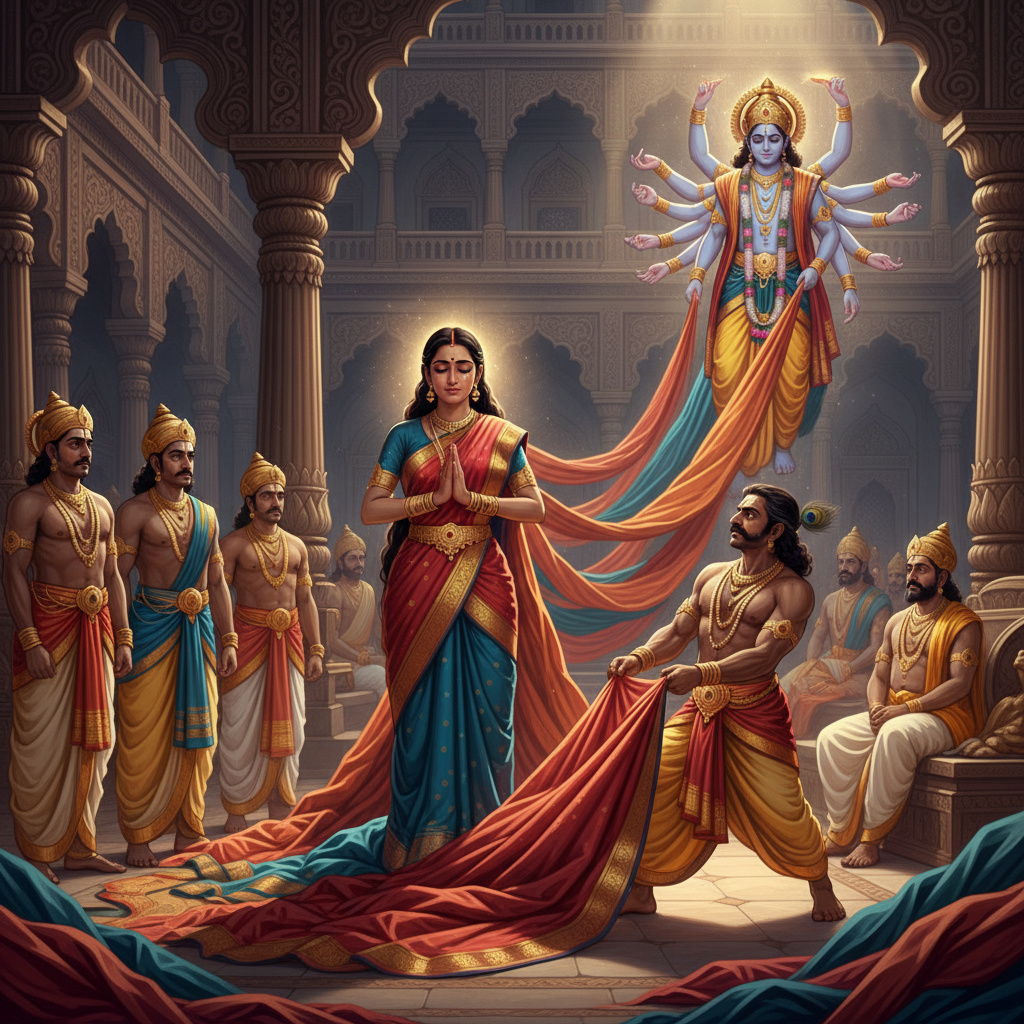
When Draupadi was humiliated by Duryodhana and Dushasana in the courtyard, the Pandavas were powerless because they had lost everything in a dice game. Draupadi cried, looked around for help, and eventually surrendered to Krishna. Immediately, Krishna intervened.
Duryodhana and Dushasana represent the aggressive, pressurized tendencies of the psyche itself.
Draupadi is also the psyche itself, pressurized — in effect, Duryodhana becomes Draupadi. Aggressiveness bounces back on the psyche itself.
Pandavas represent sensory organs — perceiving, but not organizing or amplifying.
This shows that resisting or fighting thoughts is like fighting the self. Pressure is only increased. Correct approach: attuning with higher inner intellect (Krishna / inward vibration).
Key takeaway:
Fighting thoughts = increasing internal pressure (Draupadi resisting herself).
Indulgence = giving in to the mental chaos without observation.
Surrender to inward vibration = amplification to inner intellect; psyche observes mental movies without disturbance.
Practical Guidance for Meditation
Close your eyes, optionally use cotton balls or earplugs.
Take 2–3 conscious breaths, shifting awareness inward.
Slowly deepen observation to hear inward sound.
Attune your psyche to inward vibration or sound.
Observe thoughts passively; do not fight or indulge.
Psyche will naturally shift planes and observe mental movies without disturbance.
Meditation is a relaxation practice, not a struggle. Even short periods, done with deep attunement, are far more valuable than long durations without focus.
Warning (Sweet Caution)
Sudden enthusiasm upon learning these subtle facts may tempt you to meditate for long hours at once. Do not overdo it. Layer-wise evolution at subtle gland, nervous system, and spinal levels takes time. Follow your body’s signals. If your capacity is 10 minutes, meditate for 10 minutes with full depth — intensity and synchronization matter more than duration.
Final Reflections
Indulgence or fighting is not the solution. Surrender to inward vibration allows the psyche to amplify into higher intellect and shift its plane. Thoughts continue their activity but cannot disturb the psyche. The ultimate release happens when the psyche aligns with infinite consciousness — omnipresence is achieved, pressure dissolves, and the mind experiences true freedom.

🕊️ I will be there with you with another content, and always remember: there is a long way to go: so many tunnels, so many mountains, a very long path… 🌌
✨ Want to explore deeper spiritual insight?
🔍 Just because you see nothing, doesn’t mean nothing is there…
⚔️ Kurukshetra is within — ego vs surrender
Disclaimer:
The content presented on this blog represents my personal opinions and experiences. It is based on my listening to the inward sound (Omkaranadam), my personal vision, and my forward intuition. While the ideas shared are deeply meaningful to me, they are not random statements, nor should they be interpreted as verdicts, prescriptions, or advice for anyone.
This content is meant purely for personal reflection, discussion, or exploration of philosophical and spiritual ideas. Readers may choose to engage with it as a discussion about consciousness, God, or spiritual exploration, or simply as a creative and thought-provoking experience.
I do not claim any authority, and no part of this content is intended to insult, offend, or challenge any religion, belief, or individual. It is a humble sharing of my journey and insights with the wider universe of readers and seekers.
Related Articles
Explore the Inner Journey
Dive deeper into the psyche, silence, and the subtle movements of consciousness.